3 Best Trailers That Haul Your Motor Bike Without the Headache
You don’t need a massive truck bed or a complicated hitch setup to get your bike where it’s going. You just need a trailer that won’t fight you at every turn. We’ve tracked down three solid options that balance weight, durability, and ease of use. Black Widow’s AMC-400 kicks things off with a 400 pound capacity and anti-wobble tech. But if you’re hauling two bikes, the VEVOR 600 pound model changes the game. Ready to ditch the headache? Let’s walk through your
| Black Widow AMC-400 Aluminum Motorcycle Carrier |  | Best Lightweight | Weight Capacity: 400 lbs | Hitch Compatibility: Class III or IV, 2-inch receiver | Material: High-strength aluminum | VIEW LATEST PRICE | Read Our Analysis |
| Motorcycle Wheel Chock for Trailer 1800 lbs Capacity | Best Heavy-Duty | Weight Capacity: 1800 lbs | Hitch Compatibility: 2-inch receiver (implied for trailer use) | Material: 8-gauge steel | VIEW LATEST PRICE | Read Our Analysis | |
| VEVOR 2-Bike 600 LBS Aluminum Motorcycle Carrier |  | Best for Two Bikes | Weight Capacity: 600 lbs | Hitch Compatibility: 2-inch receiver | Material: Anodized aluminum alloy | VIEW LATEST PRICE | Read Our Analysis |
More Details on Our Top Picks
Black Widow AMC-400 Aluminum Motorcycle Carrier
If you’re hauling a dirt bike or e-bike behind your SUV, this carrier is a smart lightweight pick. It supports up to 400 pounds and fits bikes with wheels 5.5 inches wide. Use it with a Class III or IV 2-inch hitch. The roll-on/roll-off ramp installs on either side for easy loading. An anti-wobble device keeps things stable, and a youth bike spacer adapter handles smaller bikes. You get an anti-tilt device too. With over 2,000 reviews averaging 4.5 stars, it’s a proven performer. Amazon offers a 30 day return policy.
- Weight Capacity:400 lbs
- Hitch Compatibility:Class III or IV, 2-inch receiver
- Material:High-strength aluminum
- Loading Ramp:Roll-on/roll-off self-storing ramp, installs on either side
- Wheel Size Compatibility:Wheels up to 5.5 inches wide
- Stability Features:Anti-wobble device, anti-tilt device
- Additional Feature:Anti-wobble device included
- Additional Feature:Self-storing ramp design
- Additional Feature:Youth bike spacer adapter
Motorcycle Wheel Chock for Trailer 1800 lbs Capacity
You need a wheel chock that can handle the toughest bikes, and this 1800 lbs capacity model is the heavy-duty workhorse for you. It’s built from robust 8-gauge steel, so it won’t buckle under pressure. Whether you’re hauling a cruiser, sportbike, or dirt bike, its adjustable fitment handles wheels from 15 to 21 inches in diameter and 3 to 5 inches wide. The upright design locks your bike vertically, preventing tipping or shifting. Use it for trailers, trucks, garages, or workshops. You get adjustable height settings and wheel locks for versatility. Plus, there’s a 30-day guarantee for peace of mind. Simple, sturdy, secure.
- Weight Capacity:1800 lbs
- Hitch Compatibility:2-inch receiver (implied for trailer use)
- Material:8-gauge steel
- Loading Ramp:Not specified
- Wheel Size Compatibility:Wheels 15-21 inches diameter, 3-5 inches wide
- Stability Features:Adjustable height settings, wheel locks
- Additional Feature:Adjustable height settings
- Additional Feature:8-gauge steel construction
- Additional Feature:Upright vertical support design
VEVOR 2-Bike 600 LBS Aluminum Motorcycle Carrier
For carrying two bikes without a trailer, the VEVOR 2-Bike 600 LBS Aluminum Motorcycle Carrier is your go-to. You get a durable anodized aluminum frame that laughs off corrosion, plus a 3.9-foot self-storing loading ramp that eliminates heavy lifting. Just attach it to any 2-inch hitch receiver.
Here’s what you’ll find in the box:
- Eight ratchet straps and hook stabilizers for security.
- Extra straps and a carrying bag for convenience.
This carrier handles scooters, dirt bikes, or heavyweight motorcycles easily. Setup is straightforward, and the 600-pound capacity covers two bikes. You also get a manufacturer’s warranty and Amazon’s 30-day return policy for peace of mind.
- Weight Capacity:600 lbs
- Hitch Compatibility:2-inch receiver
- Material:Anodized aluminum alloy
- Loading Ramp:3.9 ft self-storing loading ramp
- Wheel Size Compatibility:Not specified
- Stability Features:Eight ratchet straps, hook stabilizers
- Additional Feature:Holds two motorcycles
- Additional Feature:Includes eight ratchet straps
- Additional Feature:Corrosion-resistant anodized aluminum
Factors to Consider When Choosing a Trailer for Motor Bike
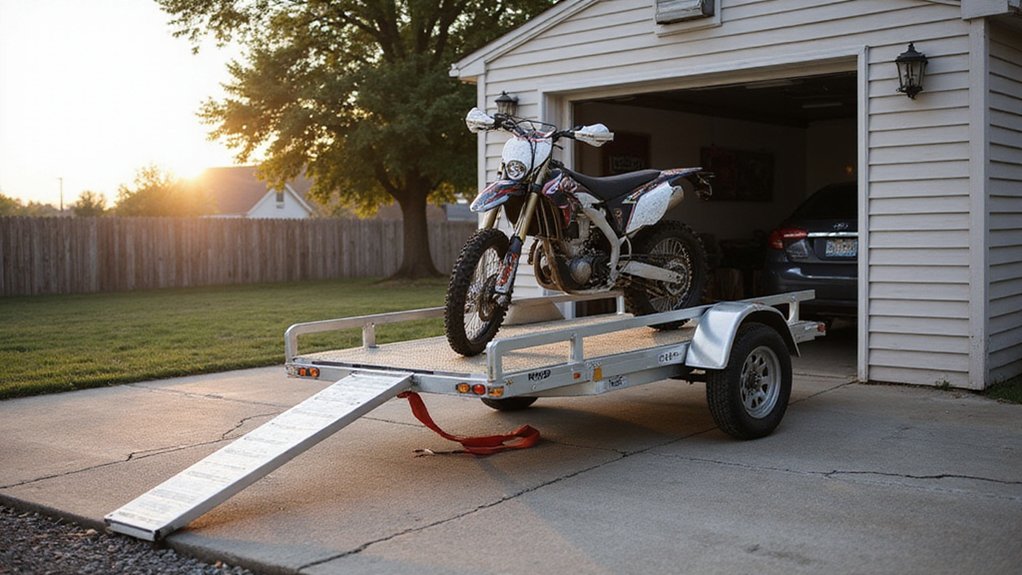
Before you pick a trailer, you need to nail down a few key specs. Your bike’s weight and your vehicle’s hitch class are non-negotiable, so check your capacity and hitch compatibility first. Then, look for a solid steel or aluminum construction, a smart loading ramp design, and anti-wobble features to keep your ride stable on the road.
Capacity and Weight Limits
Why does the weight limit matter so much? Because overloading isn’t just a hassle; it’s dangerous. You need a trailer whose capacity exceeds the combined weight of your bike plus any gear, tools, or tie-downs you’ll bring. Always check the trailer’s maximum load rating against your heaviest motorcycle. If you plan to haul multiple bikes or heavier models regularly, opt for a higher weight limit from the start.
Don’t forget the trailer’s design must support your specific bike’s size and weight, including wheel width and overall dimensions. Account for extra pounds from accessories, protective padding, and straps. I’ve seen folks overlook this and end up with a sagging trailer. Avoid that headache. Do the math first, then pick a trailer that gives you a comfortable margin. It’s simple: match the numbers, stay safe, and you’re golden.
Hitch Compatibility Matters
Once you’ve nailed down the weight specs and capacity needs, hitch compatibility becomes your next critical checkpoint. You’ve got to match the trailer’s hitch size to your vehicle’s receiver—2-inch hitches are common, but double-check. Don’t overlook your vehicle’s hitch class (Class III or IV, for instance); it dictates the max weight and stability you can expect. Confirm both trailer and carrier share compatible weight limits to avoid an overloaded setup. Look for a hitch that lets you mount and dismount without extra adapters—keeps things simple. And you’ll want anti-wobble features in the connection; they reduce movement during transit, boosting safety and your peace of mind. Get this right, and you’re set for a steady ride.
Construction Material Quality
What’s the backbone of a trailer that’ll last you years without bending, snapping, or rusting out? It’s the construction material quality, plain and simple. You’ve got two main contenders: aluminum and steel. Aluminum trailers are lightweight yet strong, making them easier to tow and kinder to your vehicle’s suspension. Steel trailers, on the other hand, offer higher strength and durability, but they demand extra maintenance to fend off rust. Either way, you’ll want weather-resistant materials to fight rain, snow, and UV damage. That choice directly impacts how safely your trailer hauls heavy motorcycle loads without warping or breaking. So, pick wisely, because a flimsy frame isn’t just a headache—it’s a hazard.
Loading Ramp Design
How do you get your bike on the trailer without a struggle? You need a ramp that works as hard as you do. Look for aluminum construction; it’s lightweight and resists corrosion, so you won’t dread lifting it. A self-storing ramp that mounts on either side simplifies loading and saves space, a huge win for tight garages.
Check the ramp’s surface. Textured or serrated patterns give you better traction, meaning no slipping when your bike’s tires hit the metal. For maximum adaptability, choose an adjustable or foldable ramp; it conforms to different bike sizes and tucks away neatly. Most importantly, confirm the weight capacity matches or exceeds your motorcycle’s heft. That’s your safety net. A smart ramp turns a two person struggle into a solo, fifteen minute job. Simple, right?
Stability and Anti-Wobble Features
With a solid loading ramp in your corner, the next big question is how your bike stays put once it’s up there. Stability isn’t just a luxury; it’s a non-negotiable. Look for anti-wobble devices that kill excessive movement before it starts, keeping your ride smooth. Reinforced frames and secure mounting points lock your bike upright, so you’re not fighting a tilt at every turn.
Properly designed wheel chocks are your first line of defense, preventing that dreaded side-to-side shift. Pair them with adjustable, lockable tie-down points to eliminate wobble from loose attachments. And remember, a low center of gravity in the trailer’s design does the heavy lifting, reducing sway and tipping risk.
Don’t overlook these details: they turn a shaky haul into a confident cruise.
Wheel Size Adjustability
Since your motorcycle’s wheel size can throw off the whole setup if it doesn’t fit right, you need to make sure the trailer’s support system adapts easily. Look for a wheel chock that adjusts to diameters between 15 and 21 inches, so you’re covered whether you ride a small dirt bike or a fat-tired cruiser. Adjustable straps or locks should handle widths from 3 to 5 inches, cinching down without fuss. Height adjustments matter too, because tire profiles vary wildly, and you want a snug, stable fit that doesn’t shift mid-haul.
Check the mountings specifically for your bike’s dimensions before committing. A versatile mechanism means no drilling, no shims, no headaches. You’ll back it on, lock it down, and hit the road, knowing the trailer adapts to your machine, not the other way around. That’s the sweet spot!
Storage and Portability
What good is a perfect trailer setup if it’s a nightmare to store or haul around when you’re not riding? You need a trailer that tucks away without the fuss. Go for foldable ramps and self-storing features. They make loading your bike a breeze or compacting everything into a tight garage corner.
Check the trailer’s weight; an aluminum design keeps it light for easy handling, while steel offers rugged durability at a heavier cost. Look at its size when folded. You don’t want something that swallows your entire storage unit. Secure attachment points and anti-wobble mechanisms lock it down during storage, preventing that annoying shift when you’re commuting between rides. Choose smart. Keep your setup stress free, even when it’s not in action.
Warranty and Return Policy
How do you protect your investment if something goes wrong? You need a trailer with a thorough warranty that covers manufacturing defects and transport damage. Look for a return policy of at least 30 days. That gives you time to inspect everything and request an exchange or refund if needed.
Review the fine print. Does it include replacement parts, repairs, or a full product replacement? And make sure the seller or manufacturer offers real customer support for claims and troubleshooting. You don’t want to be stuck figuring it out alone.
Know the conditions for returns. Are they accepted for shipping damage or simple dissatisfaction? You’ll likely need proof like photos or documentation. So keep those boxes and receipts. A solid warranty and fair return policy saves you headaches down the road. Don’t skip this step!