Class 3 Vs Class 4 Receiver Hitch: Which Should You Choose?
Would you choose a Class 3 or a Class 4 receiver hitch for your trailer? The right choice depends on how much weight you’re towing and your vehicle’s setup.
Generally, Class 3 hitches handle lighter loads, while Class 4 hitches are built for heavier towing needs.
Knowing which hitch to pick can be confusing, but understanding your trailer’s weight and your vehicle’s capabilities will guide you.
Keep reading to find out exactly how to make the best choice for your towing situation.
Class 3 Vs Class 4 Hitch: What Actually Changes in the Numbers?
Though both Class 3 and Class 4 hitches use a 2-inch receiver tube and often rely on a 5/8-inch hitch pin, the primary distinction lies in their ratings and construction. Class 4 hitches are built with heavier steel and feature more robust frame mounting points—typically 6 to 8—compared to the 4 to 6 mounting points found on Class 3. This enhanced structural design directly translates into higher weight capacities, with Class 4 hitches supporting roughly 2,000 pounds more Gross Towing Weight (GTW) and about 200 pounds more tongue weight than Class 3 models. Despite sharing the same receiver size, accessory compatibility remains consistent, but you cannot assume the same capacity for a ball mount without considering the hitch’s rated strength. The underlying hitch construction is what ultimately determines the safety margins and towing limits. For example, understanding class ratings helps clarify that Class 4 supports up to 10,000 lbs. GTW while Class 3 supports up to 8,000 lbs. GTW. For moving heavy loads, using furniture dollies designed for such weight ranges can simplify the process of repositioning bulky items around a worksite. To properly secure these heavier loads, you must also account for the hitch pin size and grade, as the 5/8-inch pin is a common but not universal standard across both classes. Following the proper step-by-step guide for installation ensures that frame mounting points are torqued to specification and the hitch remains securely fastened under load.
Class 3 Vs Class 4: What Trailer Weight Can You Tow?
Class 3 hitches typically handle up to 8,000 pounds gross trailer weight (GTW) and support 300 to 800 pounds of tongue weight. If your trailer exceeds these limits, a Class 4 hitch becomes necessary. For those who frequently haul heavy loads, reading best bike trailer reviews can help identify which hitch class pairs best with your towing needs. Class 4 hitches start at 5,000 pounds GTW but can easily accommodate up to 10,000 pounds GTW, with tongue weights reaching 1,200 pounds. The main difference is that Class 4 hitches are designed for larger, heavier trailers. If you are towing under 6,000 pounds, a Class 3 should suffice. For trailers approaching or exceeding 8,000 pounds, a Class 4 provides the additional capacity needed. Keep in mind that adding weight-distributing equipment can improve the tow capacity of both classes, but the hitch’s maximum rating is what ultimately determines your safe towing limit. For a detailed comparison of top cargo carrier hitches for quality and value, reviews highlight that choosing the right class is essential for both performance and safety. If you plan to tow a collapsible folding wagon or similar heavy gear, a Class 4 hitch offers the extra capacity for secure transport.
Does Your Vehicle Support a Class 4 Hitch (Or Stick to Class 3)?
Not every vehicle can support a Class 4 hitch. Typically, full-size trucks and large SUVs with robust frames are the primary candidates. Smaller SUVs and lighter vehicles rarely meet the structural demands required for the extra weight and size of a Class 4 hitch. As part of the preparation and final safety check, always verify that your vehicle’s frame has the necessary structural integrity before attempting installation. A well-chosen yard cart for lawn mowers can also benefit from a properly rated hitch for safe towing.
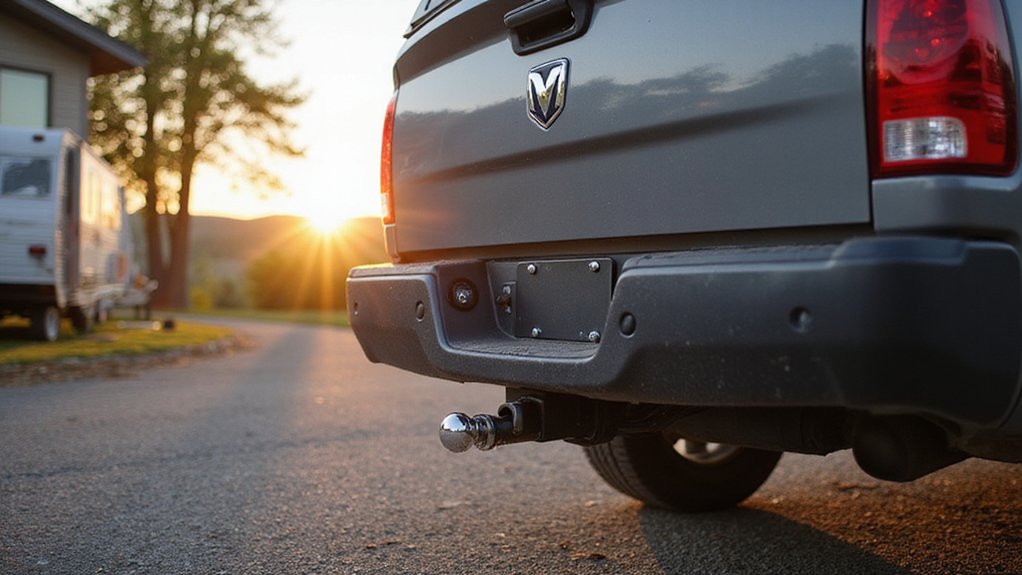
The key factor is your vehicle’s frame. Look for direct frame-rail mounting points, not bumper attachments, to support the heavier load. The 2-inch receiver opening may look similar to a Class 3, but the critical difference lies in the mounting points and the vehicle’s capacity. Receiver hitches are categorized by their GTW and tongue weight ratings, which dictate the maximum load each class can safely handle.
Installation requirements for a Class 4 hitch are more demanding, often involving six to eight mounting bolts and wider side plates to ensure strength and stability. Always check your vehicle’s exact year, make, model, and trim against the hitch’s fitment chart. If your vehicle isn’t listed as compatible with a Class 4, you will need to stick with a Class 3 hitch. Class 4 hitches have a maximum GTW of 10,000 lbs, far exceeding the capacity of most lighter vehicles.
Can’t Use a Class 4? When a Class 3 Hitch Is Still Enough
If your trailer and vehicle stay within mid-range limits, a Class 3 hitch already provides sufficient capacity for most towing needs. You don’t need to upgrade to a Class 4 unless your trailer exceeds 8,000 pounds gross weight or your tongue weight surpasses 800 pounds. With a 2-inch receiver, your hitch compatibility is solid, especially when hauling small utility trailers, boats, or light campers. Properly securing your bicycle trailer ensures you can achieve a safe, stable connection similar to towing a lightweight boat. While a Class 4 offers extra headroom, it’s unnecessary for occasional towing or when your vehicle’s rating caps your system. Additionally, heavier hardware often costs more without offering tangible benefits for lighter loads. Always verify your vehicle’s tow rating and tongue weight; if they align with these limits, a Class 3 hitch remains a safe and reliable choice. For lighter loads, a Class 3 hitch can also safely support a DIY bike kayak trailer built with basic materials.
Final Decision: Which Hitch Class for Your Truck and Trailer?
Start with your trailer’s loaded weight, not the receiver size, when choosing between hitch classes. Both Class 3 and Class 4 hitches can have a 2-inch receiver, but their weight capacities differ significantly. Use a Class 3 hitch if your trailer’s gross trailer weight (GTW) stays under 8,000 pounds and the tongue weight remains below 800 pounds. Opt for a Class 4 hitch if your load approaches up to 10,000 pounds GTW and 1,000 pounds tongue weight. Remember, your vehicle’s tow rating ultimately caps what you can safely pull. Never exceed this limit, even if your hitch can handle more. Class 4 hitches are designed for larger trucks and SUVs, supporting medium to large trailers. Improper technique when loading a heavy appliance can cause balance and stability issues during transport. Regular maintenance on your hitch ensures it stays reliable, and following the weight ratings of all components helps keep your towing safe. Stick to these numbers to make the correct choice every time. Additionally, adjusting the position of items on the rack can greatly improve rear rack efficiency by preventing load shifts during transit. For additional cargo support, a bed extender can help secure longer loads behind your truck.