How Many Ratchet Straps Do I Need? Load Safety Guide
Figuring out how many ratchet straps you need can seem tricky, but there are some simple guidelines. For loads under 10 feet, at least two straps usually do the trick, but weight and length matter too.
Larger or heavier cargo calls for more straps to keep everything secure and safe. Keep reading to see how to determine the exact number for your load.
Start With Length: How to Calculate Your Minimum Strap Count
Start with the cargo length to determine your minimum strap count. For loads 5 feet or shorter, use one strap if the weight is under 1,100 pounds; if heavier, opt for two straps. For loads between 5 and 10 feet, always plan for at least two straps. For every additional 10 feet beyond that, add one more strap to ensure security. Keep in mind that taller loads require longer straps to reach anchor points. Irregularly shaped cargo with gaps may need extra straps for stabilization. Additionally, choose strap length carefully to allow for full wraps around the load and proper tensioning. For watercraft like kayaks, specialized cam straps provide both security and quick release. These guidelines give you the minimum number of straps, but depending on the load’s specifics, you might need more for safety. Understanding the mechanical advantage of a wheelbarrow’s lever class can help you select the right tie-down points for irregular loads. For those using a hitch-mounted carrier, consulting a cargo carrier review can help ensure the platform itself has adequate anchor points for your strap count.
How Strap Strength Affects Your Tie-Down Count
Strap strength determines how much weight each tie-down can secure, making the total number of straps less important than their combined working load limit (WLL). Stronger straps allow you to secure more weight with fewer straps, increasing your overall securing capacity faster. However, the strength of your straps only counts if all other system components—hardware, anchors, and load points—match that rating. Using low-rated hardware diminishes your total WLL and can create weak points, so always verify that your anchor points are rated accordingly to prevent failure. When moving heavy furniture, selecting a dolly for furniture can further improve load distribution and reduce stress on your tie-down system. For similar heavy tasks, a heavy-duty cart with proper load capacity can also help stabilize items and reduce the burden on your tie-downs. For transporting gear like wagons, choosing a model with a collapsible folding design can simplify loading and free up space on your vehicle.
Even with high-strength straps, adherence to minimum tie-down rules based on load length and type remains essential. For instance, a vehicle on a flatbed typically needs at least four tie-downs, regardless of strap strength. Enhanced strap strength can improve redundancy and aid in proper spacing, but it cannot compensate for poor anchor placement or uneven load distribution. Keep the printed WLL rating in mind when calculating your total tie-down count, rather than relying solely on strap width or material strength.
The 50% Rule: Calculating Required Strap Strength
To meet the 50% rule, your securement system’s aggregate working load limit (WLL) must be at least half of the cargo’s weight. For example, for a 10,000-pound load, you need a combined WLL of at least 5,000 pounds. You determine this by multiplying the cargo weight by 0.5. Keep in mind, one strap might only contribute half of its marked WLL depending on its routing. Always base your calculations on the strap’s marked WLL, not its breaking strength. Failing to meet this minimum compromises load security and violates federal regulations (49 CFR Part 393). Remember, your total WLL is the sum of each strap’s contribution, considering how they are routed—it’s not just the sum of their label ratings. Even after a strap is tensioned, a common loosening error is failing to back off the ratchet handle fully before releasing, which can damage the webbing. Using higher-rated straps can reduce the number needed, but never cut corners when it comes to securing your load properly. To identify the most reliable options, consult reviews comparing top ratchet straps on quality and performance. Before securing any load, always ensure the truck bed extender is properly installed to prevent cargo shifting during transport.
4 Scenarios Where You Need Extra Straps Beyond the Minimum
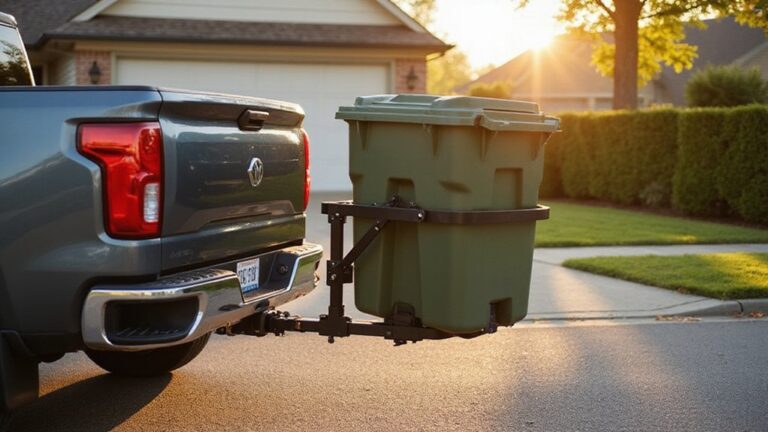
Heavy loads above 1,100 pounds require extra straps beyond the minimum. These large weights create high dynamic forces during transport, which can shift or loosen straps. To ensure load stability, use additional straps to distribute the force across multiple anchor points. This helps prevent a single strap from bearing too much weight if it loosens and maintains overall load security. For loads transported using a receiver hitch rack, ensure the rack itself is rated to handle the weight and securely attached. The hitch must be properly aligned and tightened to prevent any movement in the mounting system. For particularly heavy items, using a stair-climbing hand truck can reduce the physical strain of maneuvering them into position.
Long cargo exceeding 10 feet also calls for extra straps. For every additional 10 feet, add one more strap to control twisting, bouncing, and forward sliding. Without these, the load can sway or shift dangerously, especially on bumpy roads.
Bulky or tall loads, which raise the center of gravity, increase the risk of sway or tipping. Use cross-strapping or X-pattern securing techniques to improve lateral stability. These methods help keep the load steady from side to side during transit.
Finally, when cargo isn’t fully blocked or braced, you can’t rely solely on fixed barriers. Extra straps help compensate for missing structural restraints, preventing forward displacement and ensuring the load stays securely in place. Checking the compatibility of hardware between the rack and vehicle is essential for a safe attachment.
What About Cargo Under 10 Feet Long?
If your cargo measures between just over 5 feet and 10 feet long, federal regulations require at least two tiedowns. The key factor here is the length, not the weight. Regardless of how light or heavy the load feels, you must secure it with a minimum of two straps for this size range. This rule exists to prevent movement during transit, especially since longer cargo is more prone to shifting. Position your straps carefully by assessing your load distribution. Do not cluster the tiedowns near the center; instead, spread them out to provide even restraint. For cargo under 10 feet, you do not need to follow the “one strap per 10 feet” rule. Sticking with the minimum of two tiedowns ensures compliance and safety. Always verify that your straps are rated for the load, but remember: two straps are the federal standard for cargo between just over 5 feet and 10 feet in length. When selecting these straps, choosing models with a durable cam buckle ensures quick, secure tensioning without the extra weight of a ratchet mechanism. For example, many of the top beach wagons for sand use similarly rugged wheels that handle soft terrain without sinking. For longer trips, consider a hitch-mounted cargo box to keep your load stable and out of the vehicle’s interior.
How Blocking and Anchor Points Change Strap Count
Blocking the front of your cargo against a header-board or bulkhead significantly reduces the number of straps needed. Typically, this allows you to use just one tiedown for the first 10 feet of cargo, with an additional strap required for each subsequent 10 feet or fraction. These blocking advantages mean the straps don’t have to bear the full forward force, enabling you to meet safety requirements with fewer straps without compromising security. Additionally, the use of a flat free tire can maintain stable height and contact under load, ensuring cargo remains balanced during transit. When choosing these straps, it is best to consult a review of top ratchet straps for trucks to ensure you select durable models that hold tension reliably. For example, if you are securing a dolly on a flatbed, adding caster wheels beneath the load can reduce friction and make blocking more effective.
Anchor point strength and placement are equally crucial. Without secure, rated anchor points on both ends of each strap, your tie-downs are ineffective. Weak or poorly located anchor points force you to add extra straps or switch hardware to compensate. To evenly distribute tension and ensure secure holding, you should plan your anchor layout across multiple points, usually 4 to 8 in most truck beds. Properly arranged, a good anchor setup reduces the total number of straps needed to reach your required working load limit, especially when attaching directly to cargo points instead of vehicle anchors.
Don’t Trust Your Straps Until You Check These 5 Things
Start by checking the identification tag on the strap. If the tag is missing or if you cannot read it, treat the strap as out of service. Never exceed the specified Working Load Limit. Next, inspect the webbing for cuts, fraying, burns, or UV damage, as these weaken the strap’s strength and could lead to failure during use. Proper storage is also critical; storing straps in direct sunlight or in damp conditions can cause sun rot and degrade the material. Examine the stitching closely—loose or broken threads can signal an increased risk of failure. Move on to the ratchet mechanism, ensuring it operates smoothly without sticking or jamming, and reject hardware that appears bent or corroded. Lastly, look for signs of misuse or improvisation, such as knots, twists, or makeshift repairs, which compromise the strap’s integrity. If any damage or deterioration is found, schedule a webbing replacement immediately and tag the strap as out of service. Never attempt repairs; damaged straps should always be replaced to prevent load failure. Performing these five checks can prevent accidents caused by strap failure.