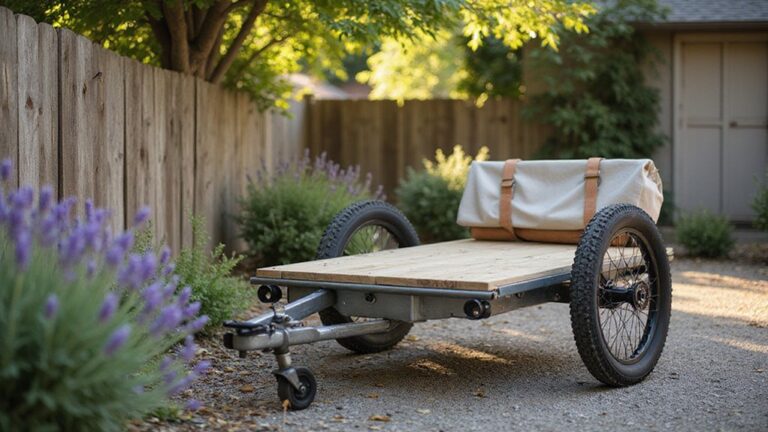

DIY Electric Utility Cart: Motorize Your Own Hauler
Building your own electric utility cart can be a smart way to haul more efficiently and save money.
Choosing the right battery setup and motor size ensures you’ll get the power and range you need based on what you plan to carry and the terrain you’ll face.
Keep reading for all the tips and tricks to get your DIY hauler rolling smoothly.
Choose 36V, 40V, or 48V for Your Utility Cart
48V is the strongest all-around choice for your utility cart, offering a good balance between range and performance. With a higher voltage, you’ll see improved battery life due to greater efficiency, allowing you to work longer between charges. Widely available charging options include dedicated 48V chargers, making recharging straightforward. To avoid component overload and ensure optimal performance, always stick with a matched system designed specifically for 48V. This setup is ideal if you need reliable power for heavy-duty tasks or longer work sessions. For moving heavy loads, consider using top furniture dollies to complement your cart. When loading equipment, ratchet straps with superior holding strength are essential for securing your cargo. Always secure any heavy items with correct tie-down angles and proper tension to prevent shifting during transport.
Match Motor Power to Slope, Load, and Wheel Size
To match your motor’s power properly, start by calculating the grade resistance for your steepest planned route and your heaviest load. For example, a 15-degree slope with a total weight of 500 pounds requires at least a 500-watt motor as a baseline. Always include additional factors like rolling resistance and a safety margin for real-world surfaces. Larger wheels, such as 16 inches, demand more axle torque than smaller 13-inch wheels for the same climb because they have a larger radius and thus require more force to turn. Remember that your braking system must handle these slopes and the extra momentum during descents; adequate stopping power is essential for safety. Match the motor’s continuous rating to your combined grade resistance and payload; a 48-volt brushless motor typically suits carts weighing from 500 to 660 pounds on slopes of 12 to 15 degrees. Overpowering your system gives you more reserve for starts and rough terrain, but underpowering can lead to poor performance and inefficient operation. When securing heavy loads to your cart, the same principles of proper tension apply, as failing to account for ratchet strap load ratings can result in shifted cargo during climbs. Reviewing top bed extenders for trucks can help you choose a hauler that matches your weight and slope needs. For heavier loads, considering a class 4 receiver hitch provides higher towing capacity for attaching a utility trailer.
Pick a Controller and Wiring That Won’t Fail
Choose a controller with a continuous current rating that matches your motor’s maximum draw and a voltage rating that aligns with your battery pack’s peak voltage. Opt for a traction-specific DC controller rather than a hobby model; it will include essential features such as proper contactors and pre-charge paths that ensure safe, reliable startup. Position the main fuse as close to the battery’s positive terminal as possible and size it at or below the controller’s amperage rating to protect both components effectively. For wiring safety, use 2 AWG or larger fine-stranded cable for high-current runs to reduce voltage drop. Connect the main negative directly to the controller terminal, avoiding routing through disconnects, and keep all high-current paths as short as possible. Seal the controller enclosure to prevent moisture ingress, and utilize corrosion-resistant terminals for outdoor durability. To ensure the system can handle the initial surge without damage, install a pre-charge resistor across the main contactor to limit inrush current during startup. When selecting your drive wheels, confirm that the load capacity rating of each caster matches your cart’s total weight plus cargo, as overloading any single wheel causes premature bearing failure and instability. For further guidance on selecting a reliable frame, consider the collapsible folding wagon designs reviewed for quality and performance to inspire your cart’s chassis layout.
Lead-Acid vs. Lithium: Which Battery Works for Hauling?
Battery chemistry matters more for a hauling cart than for a basic runabout because payload demands consistent, reliable power to prevent voltage sag, especially on hills. Lithium batteries deliver three to five times the energy density of lead-acid, significantly reducing weight and lessening stress on axles and brakes, which is crucial when hauling heavy loads. They also allow you to use nearly all their capacity, whereas lead-acid batteries require stopping at around 50% depth of discharge to preserve lifespan. Thanks to their flat discharge curve, lithium batteries maintain a steady voltage and speed under load, while lead-acid batteries experience performance drops as they drain. Maintenance differences are stark: lead-acid batteries need regular water level checks and equalizing charges weekly, whereas lithium batteries require no such upkeep. Charging protocols also vary; lithium accepts rapid top-ups, minimizing downtime, while lead-acid batteries need long absorption periods. Over their lifespan of 8 to 15 years and more than 4,000 cycles, lithium batteries outperform lead-acid options, which typically last between 2 to 5 years. Although lithium batteries come with a higher initial cost, they offer more usable work per pound and per charge, making them the smarter choice for heavy hauling tasks. When selecting a motorized hauler, consider that hand trucks or dollies offer distinct trade-offs in performance and durability for transporting your battery and payload. For moving heavy batteries, caster wheels on the dolly platform provide smooth maneuverability and reduce strain during loading. A no-weld build can further simplify the construction of your motorized hauler platform.
Calculate Battery AH for Your Payload and Range
To determine the battery amp-hour (Ah) capacity for your payload and range, start by defining your pack voltage. Since Ah alone doesn’t indicate stored energy, you’ll need to estimate your energy consumption in watt-hours per mile (Wh/mile). Heavier payloads or hilly terrain increase this figure significantly. Multiply your desired range in miles by your estimated Wh/mile to find the total watt-hours needed for your trip. Next, divide that total watt-hours by your pack voltage to calculate the required amp-hours. It’s wise to add a reserve capacity—around 10 to 20 percent—to account for real-world losses such as aging, temperature, and usage variations. Remember, your battery chemistry impacts the usable capacity and charging efficiency, so consider those factors when sizing your pack. For example, if you need 8,160 Wh from a 48V pack, you’ll require roughly 170 Ah. Heavier loads or hilly courses may mean selecting a slightly larger capacity to ensure your cart can haul reliably without running out of power. To safely secure your battery pack during transport, consider using a receiver hitch mounted cargo platform for easy loading and unloading. Using a 3-way hitch adapter can help distribute tongue weight for towing additional gear behind your cart. Ensuring your battery box uses corrosion-resistant steel for the locking mechanism will provide durability against road debris and weather.
Mount the Motor and Keep Weight Low for Stability
Mount the motor low and close to the frame and axle line to maintain stability. Positioning the motor near the rear axle helps keep the center of gravity low, reducing the risk of tipping over. Use a rigid bracket with multiple bolts to secure the motor firmly and prevent movement under load. This approach mirrors the stability principles of a hitch cargo carrier build that also avoids high, top-heavy mounting. Choosing a motor with sufficient torque prevents strain on the frame, similar to how a heavy-duty utility dolly handles uneven loads without tipping.
Avoid mounting heavy components high above the chassis. Instead, place the motor near the floor or under the seat, aligning it with the battery location for balanced weight distribution. Verify stability by checking if the cart sits level under load, and adjust the motor position if needed. Proper placement ensures your cart remains steady during turns and over bumps, minimizing tipping.
Always confirm the motor’s load rating matches your cart’s intended cargo weight, just as you would check the capacity of an appliance dolly before moving a heavy refrigerator.
Check Safety and Legal Rules Before Driving
Before driving your cart on public roads, it’s crucial to check local safety and legal rules. Vehicles that reach speeds between 20 and 25 mph are typically classified as low-speed vehicles (LSVs). If your cart exceeds this, it falls outside LSV regulations and requires different licensing and equipment. For a more stable and practical alternative, some users consider an adult tricycle with basket for short-distance hauling instead of a motorized cart. Most areas restrict LSVs to roads with speed limits of 35 mph or less. You’ll need to equip your cart with headlights, turn signals, mirrors, seat belts, and a windshield to meet safety standards. Some states may also require a safety inspection before you can legally drive on public streets. Register your vehicle, obtain a title, and insure it accordingly. Carrying a valid driver’s license is essential. Remember, private property isn’t a free pass—once you’re on a public road, the same laws apply. Always stay within the speed limit, avoid highways, and check local laws regarding age requirements and helmet use. For those who prefer a non-motorized option, a receiver hitch rack offers quality and value for transporting bikes.